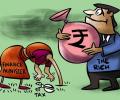
India's 18 largest states, accounting for over 90 per cent of the country's gross state domestic product (GSDP), are likely to record a marginal uptick in revenue growth to 7-9 per cent this year, from 6.6 per cent clocked in 2024-25 (FY25), rating agency Crisil said in a report on Tuesday. This growth, slower than the decadal average of about 10 per cent, would lift these states' cumulative revenue to around Rs 40 trillion in FY26 from Rs 37.26 trillion in FY25.

India's electric two-wheeler (e2W) manufacturers have urged the government to extend subsidies under the PM E-Drive (Electric Drive Revolution in Innovative Vehicle Enhancement) scheme beyond March 2026, cautioning that a withdrawal could slow near-term demand even as confidence in long-term electric mobility adoption remains intact.

Trading pattern in the stock market this week will largely depend on the ongoing Q3 earnings announcement from corporates, global trends, and foreign fund movement, analysts said. Moreover, geopolitical developments and any update on trade negotiations would also be keenly tracked by investors, experts noted.

The ministries of Road Transport & Highways and Railways have exceeded the national average capital expenditure (capex) by spending 63 per cent and 57 per cent of Budget estimates (BE), respectively, in the first half of 2025-26 (FY26). The total capital expenditure for April-September of FY26 stood at 52 per cent of the BE, according to the latest data by the Controller General of Accounts (CGA).

Tier-II, Tier-III, and rural regions accounted for 62 per cent of all new health insurance policies sold by insurers so far in 2025-26 (FY26), according to a Policybazaar report. These regions are also witnessing a rise in the sum assured opted by customers.

This is the second-worst performance by the pack during this period over the last five years since CY20.

The largest tranche came in July, in the wake of Operation Sindoor, with the DAC according acceptance of necessity -- or initial approval -- for 10 capital acquisition proposals amounting to approximately 1.05 trillion through indigenous sourcing.

Indian equities declined on Friday, with the benchmark Nifty posting its worst weekly fall since September, as foreign investor sentiment remained weak amid tepid earnings growth and little progress on the India-US trade front.

Real GDP growth surprised on the upside in 2025, but weaker nominal growth, trade uncertainty, and soft demand signal a bumpier road ahead.

For the first time, the government is likely to dip into the Oil Industry Development Fund (OIDF) to finance part of its fertiliser subsidy programme for 2025-26, according to official sources. The finance ministry has accounted for Rs 23,000 crore in the FY26 Budget as net additional resources to be drawn from dedicated reserve funds, including the OIDF, the Agriculture Infrastructure and Development Fund, and the Universal Service Obligation Fund.

'Some success has been achieved in raising the costs of terrorism for Pakistan.'

Net direct tax collection grew 8 per cent to over Rs 17.04 lakh crore this fiscal till December 17 on slower refunds and higher advance taxes from corporates, the income tax department data showed on Friday.

CAG warns most states of fiscal imprudence as March spending overshoots limits, with key departments exhausting large portions of budgets in the last month of FY24.

It will be the second Budget of the Modi 3.0 government and eighth straight Budget for Nirmala Sitharaman, rare in Indian polity.
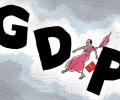
The upcoming Union Budget to be presented on February 1 is likely to assume a nominal gross domestic product (GDP) growth between 10 and 10.5 per cent for FY26, a Business Standard poll of 10 economists showed. The first advance estimates released by the National Statistics Office (NSO) had estimated a nominal GDP growth of 9.7 per cent for FY25. Nominal GDP, calculated at current market prices, factors in the effect of inflation. It is used as the base to calculate crucial macroeconomic indicators, such as fiscal deficit, revenue deficit, and debt-to-GDP ratio.

India's used car market, which has been growing steadily at 10-12 per cent over the last 2-3 years, is expected to reach $40 billion in FY26.

Having missed the target for the current financial year, Finance Minister Nirmala Sitharaman on Saturday proposed to spend Rs 11.21 lakh crore towards capital expenditure (capex) for FY26. However, the capex target is going to be missed by about 93,000 crore for the current financial year.

The government in FY26 Budget should announce an "effective" personal income tax cut to support consumption and demand, Barclays said on Thursday. In its FY25-26 Union Budget preview, Barclays said the key ask from the Budget, to be presented on February 1, is to support growth while adhering to fiscal consolidation path.

Moody's Ratings on Tuesday said tax cuts in the current fiscal has dented India's revenue growth, leaving less scope for fiscal policy support for the economy.
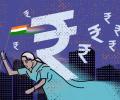
The government's indirect tax collection is expected to increase by 8.3 pc in the financial year 2025-26 (FY26), according to a report by ICICI Bank. The report also noted that this growth is higher than the 7.1 per cent increase seen in FY25 and is mainly driven by rise in GST revenue from strong urban consumption. It said "The increase is driven by higher goods and services tax collections which in-turn is explained by boost to urban consumption".

Investors must account for currency depreciation in their financial plans and use instruments that can cushion the erosion in purchasing power.
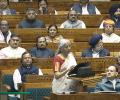
The fiscal deficit for FY25 has been pegged at 4.8 per cent of GDP and at 4.4 per cent for FY26, Finance Minister Nirmala Sitharaman said on Saturday. Presenting the Budget 2025-26, she said net market borrowings are estimated at Rs 11.54 lakh crore for next fiscal year.

Infosys, HCL, Wipro ramp up fresher intake as AI reshapes skills demand and hiring shifts from 'hire to train' to 'train to hire'.

With less than six months left for this financial year and poor response from applicants, launching the scheme this year is unlikely.

India's $280-billion IT industry heads into 2026, balancing visa-related headwinds and global trade uncertainty against its biggest-ever push into artificial intelligence and the rapid expansion of global capability centres (GCCs). Heightened scrutiny of the US H-1B visa programme - including a proposed $100,000 fee for new visas and concerns over a potential 25 per cent outsourcing tax - has complicated cross-border delivery for Indian firms, even as companies accelerate efforts to reduce reliance on onsite staffing.

India's gems & jewellery exports witnessed 30.6 per cent year-on-year (Y-o-Y) contraction in October to $2.17 million, amid the imposition of a steep 50 per cent tariff by the United States (US) on several Indian products.

Experts say Indian Railways must grow its share in the freight market to remain financially sustainable.

Finance Minister (FM) Nirmala Sitharaman has presented a forward-looking Budget, reinforcing the government's commitment to 'Reform, Perform, and Transform'.

Exchange Traded Funds (ETFs) have stepped into the spotlight this quarter. With evolving market conditions and shifting investor sentiment, ETFs offer a timely solution for accessing growth with liquidity and efficiency. In this article, we break down the most important ETF trends, performance drivers, and what to watch in the months ahead.

This will be the first full-year Budget of the BJP-led National Democratic Alliance government since it came to power for a third consecutive term in July last year.

The Indian economy recorded a six-quarter high growth of 8.2 per cent in July-September, as factories churned out more products in anticipation of a consumption boost from the GST rate cut, according to government data.

After a subdued first quarter of 2025-26 (Q1FY26), banks are now betting big on the festive season, rolling out attractive loan offers to boost credit growth in the second half of the current financial year (H2FY26) - a trend likely to be further accentuated by the second-order effects of the good services tax (GST) cuts.

India's housing finance sector is riding a wave of post-pandemic revival, driven by policy support, digital innovation, and growing demand from younger homebuyers in emerging cities.

The Indian economy is projected to grow at 6.2 per cent in 2025-26, slower than earlier estimated rate of 6.5 per cent, due to escalated trade tensions and global uncertainty, the International Monetary Fund (IMF) said on Tuesday. "For India, the growth outlook is relatively more stable at 6.2 per cent in 2025, supported by private consumption, particularly in rural areas," IMF said in its World Economic Outlook (WEO).

Finance Minister Nirmala Sitharaman on Thursday asked India Inc to take advantage of the policies and reforms undertaken by the government and no longer hesitate to invest more and expand capacities. Sitharaman also asked the industry to partner with the government for skilling the youth and also to engage with the government throughout the year, and not just before the Budget.
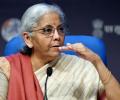
Paraphrasing Abraham Lincoln, Finance Minister Nirmala Sitharaman on Sunday described the Union Budget as "by the people, for the people, of the people", and said Prime Minister Narendra Modi was fully behind the idea to cut taxes for the middle class but it took time to convince the bureaucrats. "We have heard the voice of the middle class" who had been complaining about their aspirations not being met despite being honest taxpayers, she told PTI in an interview.

The Centre's fiscal deficit stood at 17.9 per cent of the full-year target at the end of June, according to data released by the Controller General of Accounts (CGA) on Thursday. It was at 8.4 per cent of Budget Estimates (BE) of 2024-25 in the first three months of the previous financial year.

'Make-in-India played a key role in India's effective action against terrorism during Operation Sindoor.'

Indian information-technology (IT) service providers are likely to report another quarter (July-September) of low, single-digit growth owing to macro uncertainties, chiefly emanating from America, with no respite in sight even in the second half of the year.

'We have to retain some fiscal headroom without compromising on the promised fiscal consolidation roadmap.'
 © 2026 Rediff.com - Advertise with us - Disclaimer - Privacy Policy - Sitemap - Feedback - About us - Terms of use - Grievances